Financial regulations rarely stand still for long, and every amendment or new compliance requirement carries real consequences for those it touches. Ashutosh Financial Services has long held that sound financial decisions rest on a foundation of clear, practical knowledge, which is why the organisation regularly brings together professionals and subject experts to unpack these changes in plain terms. It is with this intent that the firm organised a session on recent developments in income tax law and the importance of maintaining statutory records.
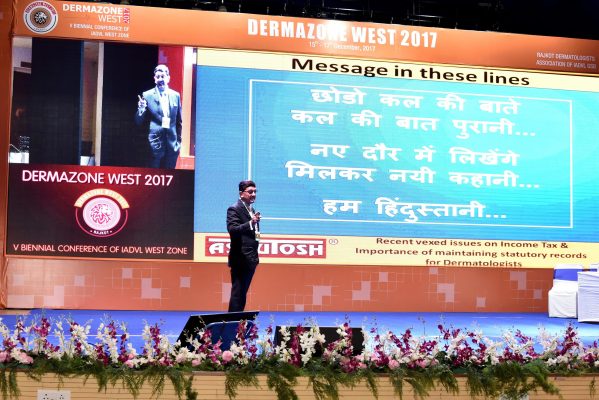
The session, titled “Recent Vexed Issues on Income Tax & Importance of Maintaining Statutory Records,” was held in Rajkot on 17th December 2017 for an audience of high-net-worth individuals, with particular relevance to medical practitioners such as dermatologists who run independent professional practices. It was led by speaker DDK. For professionals with substantial personal and practice-related income, the tax provisions discussed are not academic details but rules that directly affect how income is reported, how expenses are treated, and how assets are eventually passed on to the next generation.
A significant portion of the discussion centred on Section 44ADA, the presumptive taxation scheme available to professionals with gross receipts below Rs 50 lakh. Under this provision, at least 50 percent of gross receipts must be declared as income, failing which the professional is required to get their accounts audited. The session made an important clarification here: this is not a concession that lowers tax liability, but rather a minimum tax floor designed to ensure a baseline collection from professionals whose income might otherwise be difficult to verify. Used carelessly, however, 44ADA can create its own complications. Any assets a professional builds up that exceed what their disclosed income under this scheme can reasonably explain may be treated as unexplained, and without proper books of accounts, the process of building and later justifying those assets becomes considerably harder to defend.
The talk also covered restrictions around cash transactions, an area where the law has tightened considerably in recent years. Business expenses paid in cash beyond Rs 10,000 are disallowed as deductions under Section 40A(3), and the same threshold applies to capital expenditure, which cannot be included in the cost of an asset if paid in cash beyond that limit. Property purchases carry an even stricter cap: cash payments exceeding Rs 20,000 attract a penalty equal to the full amount involved. A related and often overlooked provision, Section 269ST, prohibits any person from receiving Rs 2 lakh or more in cash, whether in a single transaction, across transactions linked to one event, or in aggregate from one person in a day, unless the payment comes through a bank channel such as an account payee cheque or electronic transfer. The penalty for breaching this rule is equal to the amount received, making it one of the more consequential provisions for anyone accepting large payments informally.
On capital gains, the session explained the shift in the base year used for indexation from 1981 to 2001, which affects how the cost of older assets is adjusted for inflation when calculating gains. It was also noted that immovable property held for 24 months now qualifies for long-term capital gains treatment, a detail that changes the tax outcome depending on when a property is sold relative to its purchase date.
The discussion then turned to statutory record-keeping, and here the session offered a broader lens than compliance alone. Beyond the legal obligation under Section 44AA and Rule 6F, well-maintained records answer practical questions every professional should be able to answer: what is actually earned, what is actually spent, and where expenses can be trimmed. They support warranty and guarantee claims, demonstrate financial capacity when needed, and feed into the kind of management information that helps a practice grow in a more informed way. Records also matter for continuity, since assets and liabilities that are properly documented make the eventual transfer to heirs far smoother. Perhaps most pointedly, the session highlighted that assets disclosed through proper statutory records cannot be seized during search or investigation proceedings, underscoring documentation as a form of protection rather than just an administrative task.
Sessions like this reflect a simple belief: that clarity around evolving tax rules and disciplined record-keeping practices give professionals more control over their financial affairs, not less. Ashutosh Financial Services continues to organise such educational initiatives because informed decisions, made well ahead of any compliance deadline or scrutiny, remain the most reliable safeguard any individual or practice can have.