Every year, thousands of Rajkot families send a son or daughter abroad for work, study, or a new life altogether—and along with that move comes a tangle of banking rules, tax questions, and RBI regulations that few people fully understand until they run into them. This is exactly the gap Ashutosh Financial Services set out to address when it began organising sessions on non-resident Indian finance. The belief driving these sessions is simple: people make sounder financial decisions when they understand the rules governing their money, not just the outcomes those rules produce.
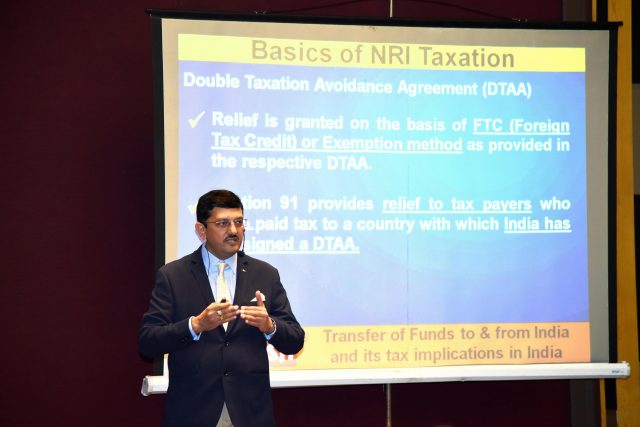
On 1st December 2018, Ashutosh Financial Services held a session in Rajkot titled “Transfer of Funds to & from India and its Tax Implications in India,” aimed specifically at the city’s large NRI community. The speaker, Daxesh Kothari, walked attendees through a subject that touches nearly every NRI household at some point—whether it’s remitting money home, managing property, or eventually planning a return to India.
The session opened with a question that sounds simple but rarely has one clean answer: who exactly is an NRI? As Kothari explained, the answer depends on which law is asking. The Income Tax Act looks purely at the number of days spent in India during a financial year—182 days or more, or a combination of 60 days in the current year and 365 days across the preceding four years, with exceptions for those leaving India for employment. FEMA, the Foreign Exchange Management Act, takes a different view altogether, focusing on a person’s intent and conduct rather than day counts—someone who has left India to take up employment or business abroad, for instance, is treated as a non-resident regardless of how many days they later spend visiting. Then there’s the Citizenship Act, which classifies people by how they acquired citizenship, and the OCI framework, which governs eligibility for Overseas Citizen of India status. These four classifications don’t always align, which is why an individual’s residential status can genuinely differ depending on which authority is being consulted.
From there, the session moved into how taxation actually works for NRIs. Kothari outlined the residence and source rules that determine what gets taxed, and explained how India’s Double Taxation Avoidance Agreements—signed with more than 89 countries including the US, UK, UAE, and Australia—prevent the same income from being taxed twice. For income earned in countries without a DTAA, Section 91 of the Income Tax Act still offers relief. A useful table compared how a Resident and Ordinarily Resident, a Resident but Not Ordinarily Resident, and a Non-Resident are each taxed on Indian versus foreign income, followed by a detailed comparison of how specific income types—interest on NRO and NRE accounts, sale of property, mutual fund gains, dividends—are treated differently in India versus the US.
Banking formed the next major thread. NRIs cannot hold a regular resident savings account in India; it must be converted to an NRO account once residential status changes. The session distinguished between the four account types available—NRO for income earned in India, NRE for foreign earnings that need to remain repatriable and tax-free, FCNR for holding deposits in foreign currency, and RFC for returning NRIs who want to retain foreign assets after coming back permanently.
Practical transfer rules were covered in depth too: the timelines for settling import and export payments, the conditions under which advance payments can be made or received, and the equalisation levy applicable on payments like online advertising to non-residents. The Liberalised Remittance Scheme, which allows a resident individual to remit up to US$250,000 per financial year, was explained alongside the specific conditions for loans and gifts—both directions, resident to NRI and NRI to resident—including which route requires the funds to pass through an NRO account and which allows direct foreign currency transfer.
The session closed with guidance particularly relevant to those planning to move back to India: how bank accounts convert on return, what happens to existing NRE and FCNR deposits, and the rule allowing up to US$1 million to be moved annually from an NRO account to an NRE account or abroad, provided applicable taxes have been settled.
Financial rules for NRIs will keep evolving as regulations are updated and global mobility increases, which is precisely why staying informed matters as much as any single transaction. Ashutosh Financial Services continues to organise sessions like this one because clarity on these rules protects people from costly mistakes—and that kind of practical, ongoing education remains central to the work it does in Rajkot and beyond.