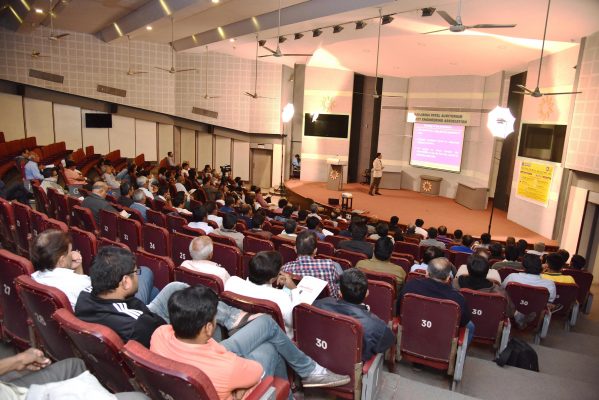
Financial decisions rarely stay simple once real money is on the table, and borrowing is one of those areas where a small shift in approach can mean lakhs of rupees saved or lost over the years. It is this belief — that sound decisions start with sound understanding — that keeps Ashutosh Financial Services returning to the classroom format again and again, bringing together practitioners and their clients to unpack ideas that usually stay buried in fine print.
On 11th January 2018, the firm organised a session in Rajkot titled “Funding (Loan) options in the present times & Provisions for deduction of Interest Expenses under Income Tax Law.” The audience comprised high net worth individuals, many of whom deal with borrowing decisions not as occasional events but as an ongoing part of managing businesses, properties, and investment portfolios. The speaker, Daxesh Kothari, structured the session around a simple premise: borrowing itself isn’t the problem, but borrowing without a clear strategy usually is.
The session opened by mapping the lending environment as it stood at the time. Banks were sitting on surplus liquidity, and competition between public sector banks, private banks, and NBFCs had intensified. This mattered because it shifted some negotiating power toward borrowers, provided they knew how to use it. Kothari walked through how RBI’s repo rate cuts between 2016 and 2017 filtered through to actual lending rates, showing that even a modest 0.50% reduction in the repo rate translated into a much larger 1.20% drop in effective borrowing costs — a reminder that headline policy moves don’t always match what shows up on a loan statement.
From there, the discussion turned to how lenders behave in a competitive market — rolling out attractive introductory rates, prioritising borrowers with visible repayment capacity, and relying on charges like processing fees and prepayment penalties as a steady revenue stream. Understanding this helped frame the second half of the session: what borrowers themselves should be doing differently. A recurring theme was that financial strength needs to be demonstrated on paper, not just held privately, since documented strength is what actually translates into better rates and terms. The CIBIL score came up as a central factor in this evaluation, and Kothari broke down what actually shapes it — repayment history, how much of the available credit is being used, the tenure of credit lines, how often new credit is sought, and the mix of credit types held. The practical takeaway was straightforward: monitor your credit report regularly and get errors corrected promptly, since incorrect entries can quietly work against a borrower for years.
A significant portion of the session addressed the discipline around borrowing itself. The advice was consistent and, in places, deliberately cautionary: never borrow to invest in illiquid assets like real estate, never take on debt simply because it is available, and never mismatch short-term borrowed funds with long-term investments, since that mismatch is often where financial stress originates. A comparison between a fixed deposit-linked overdraft and one linked to a debt mutual fund illustrated this point numerically, showing a meaningfully lower net interest cost with the mutual fund route — though, as the presentation noted, mutual fund investments carry market risk and should be read about carefully before acting.
The session also covered how tax law treats interest expense, which is where many borrowers unknowingly leave money on the table. Interest on capital borrowed for business or professional use is deductible under Section 36(1)(iii), provided the funds are actually used for income-generating purposes — a dominant non-business purpose can disqualify the claim. Interest paid on loans taken to acquire a house property is deductible against rental income without limit under Section 24(b), though the maximum loss allowable under that head is capped at Rs. 2 lakh, with the balance eligible to be carried forward. Interest incurred to earn income under “other sources” is deductible under Section 57(iii), while interest paid to earn exempt income such as dividends or long-term capital gains on shares is specifically disallowed under Section 14A. The session also touched on inter-corporate loan restrictions under Sections 73 and 185 of the Companies Act, along with practical notes on loan-against-property, cash credit facilities, and structured options like project finance and bill discounting for businesses.
The session closed on a note that summed up its underlying philosophy well: borrowing itself is not something to fear, but how the funds are borrowed, and what is done with them afterward, is what ultimately determines whether debt becomes a tool or a trap. It’s the kind of distinction that only becomes clear with the right context — and building that context, one session at a time, remains part of what Ashutosh Financial Services continues to invest in for the communities it works with.